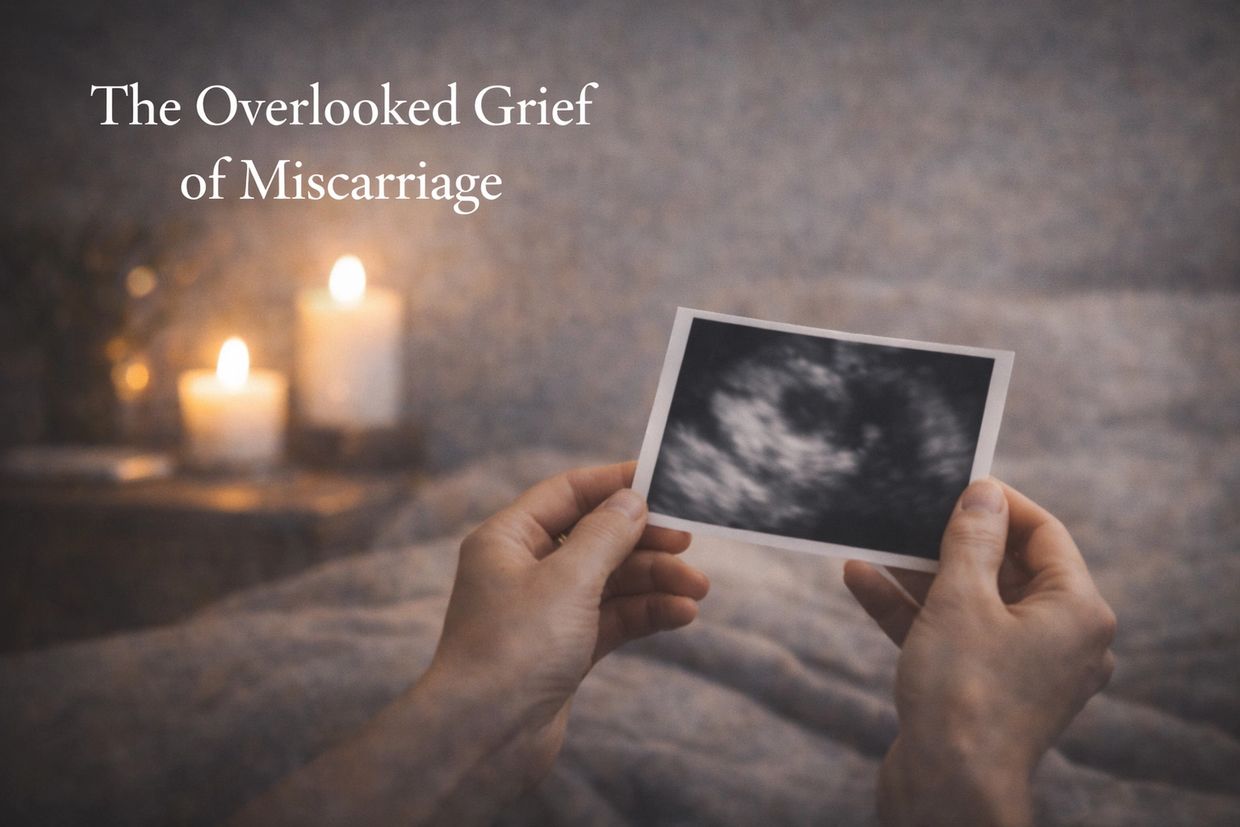
When most people think about grief, they imagine the loss of a loved one who lived in the world, someone with stories, memories, and shared time. But there is another form of grief that is quieter, less visible, and often left unspoken: the grief of miscarriage.
For those who go through it, miscarriage can be one of the most disorienting and isolating experiences of their lives. It is a grief that society often minimizes, but it is no less profound. And because it goes unrecognized, many feel as if they are grieving in the shadows (carrying the weight of something the world doesn’t see).
Why Miscarriage Grief Is So Often Overlooked
One of the reasons miscarriage grief is overlooked is because it doesn’t fit into the traditional scripts of loss. There is no funeral, no obituary, no socially sanctioned way to mark the moment. In many cultures, pregnancy itself is often kept private during the earliest weeks. When a miscarriage happens, it may do so before anyone beyond the immediate household even knew. That leaves the grieving parents in the paradox of mourning something that feels monumental but invisible to everyone else.
There is also the silence created by stigma and shame. Even though medical research shows miscarriage is incredibly common (as many as one in four pregnancies end this way), many who experience it still feel a sense of personal failure. They ask themselves whether they did something wrong, ate the wrong food, exercised too much, didn’t do enough. The truth is that miscarriage is usually beyond anyone’s control. But the self-blame lingers, and with it, silence.
And then there’s the absence of ritual. With other forms of loss, we have cultural practices to help us mourn. When someone dies, there is a service, a gathering, a time when others show up with casseroles, cards, and words of sympathy. With miscarriage, there is often none of that. The loss happens in private, and without shared rituals, many people are left unsure how (or if) they are supposed to grieve at all.
Grieving the Potential Of
What makes miscarriage grief especially unique is that it is not only about what was lost, but what could have been.
From the moment someone knows they are pregnant, their mind often leaps ahead: imagining baby names, envisioning first birthdays, picturing the way their life will shift. Even in the earliest days, there is a story already being written in the imagination (a story of the future).
When miscarriage happens, that imagined future disappears in an instant. It is not only the end of a pregnancy; it is the loss of the potential of a child, a family, a dream. Grieving that potential can be deeply confusing, because it is grief over something that never had the chance to exist in the physical world. Yet it is very real, and for many, just as painful as any other loss.
The Emotional and Physical Layers
Grief after miscarriage is not only emotional. It is physical, too.
The body, having begun the process of pregnancy, goes through rapid hormonal changes. When a miscarriage occurs, those hormones can drop suddenly, triggering mood swings, exhaustion, and symptoms that resemble postpartum depression. The physical recovery can bring reminders of the loss in ways that feel inescapable.
Emotionally, grief can show up as sadness, guilt, shame, anger, or numbness. Some people feel an immediate need to talk about it, while others shut down, unsure of what to say or how others will respond. Partners may grieve in different ways, leading to feelings of disconnection or misunderstanding. Friends or family may unintentionally say things like, “You can try again” or “At least it was early” (phrases that may be meant to comfort but often minimize the pain).
This mix of physical and emotional layers makes miscarriage grief uniquely complicated. It is not just about loss; it is about the loss happening inside your own body, and then being asked to carry on as if nothing happened.
Steps Toward Reframing the Grief
While there is no single path to healing, reframing the grief of miscarriage can help create space for gentleness and meaning. This does not mean erasing the pain or rushing past it. It means finding new ways to hold it that allow both grief and love to coexist.
1. Acknowledge it as grief.
Miscarriage is a loss. Naming it as such validates your experience and helps dismantle the internalized message that you should “just move on.”
2. Create your own rituals.
Since society doesn’t provide rituals for miscarriage, it can be powerful to make your own. Some write letters, light candles, plant trees, or create small keepsakes to honor the life and the love that was present. Ritual gives grief a container.
3. Honor the potential.
Instead of trying to dismiss what was lost as “too early,” allow yourself to honor the future you had already begun to imagine. It was real to you, and that makes it worthy of acknowledgment.
4. Shift the inner dialogue.
Instead of staying with “Why did this happen to me?”, try asking “How can I carry the love I felt forward in a way that honors me and my baby?” This reframing doesn’t erase the sorrow, but it changes how the story is told inside your heart.
5. Offer yourself compassion.
Self-blame is common, but it is undeserved. Speak to yourself with the same tenderness you would offer to a dear friend who had gone through the same experience.
Moving Forward with Compassion
Miscarriage is not a small loss. It is not something to be minimized or brushed aside. It is a grief that deserves acknowledgment, space, and compassion.
Over time, the pain may soften, but it may never disappear. That is the nature of grief: it stays with us, even as we grow around it. What can change is the weight of silence. By naming the grief, honoring the potential, and reframing the way we carry it, we can move from isolation to connection, from shame to gentleness.
You may always remember this loss, but that memory can evolve from quiet suffering into a quiet honoring. The love you carried matters. The grief you carry matters. And most importantly, you matter.
Article: Toni Filipone
